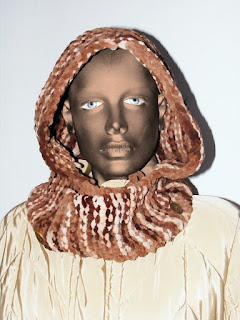
Inspiration can come from different places, this time it came from the cold. The icy cold of the north of recent days has inspired the creation of this hood, soft and light but above all warm.
The yarn used is Stafil rastacolor, I call it fleece yarn but it is also called chenille yarn; the reason why I call it fleece is that I'm used to considering chenille made with 'fresher' materials such as viscose, but in the end the yarn is done the same way: tufts of 'fur' held together by a thin and strong thread.
The works made with these yarns can appear heavy, in reality it is a very light fiber, the thickness of the yarn makes the processing quite fast even if in some cases it is necessary to adopt some precautions as it is not a very smooth yarn especially in the bolt work. But we will see it in the explanation of the scheme of this hood.
I was saying ... the yarn is the Stafil rastacolor, the color is n ° 13 light / dark brown (I used about 3 and a half), it is worked with needles from 8 to 12, I used the n ° 8 . You also need 8 buttons and a pointed wool needle and a size 7 or 8 crochet hook.
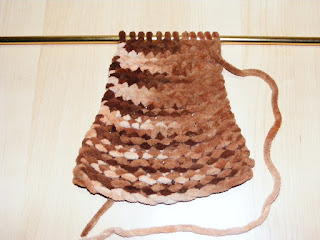
12 stitches are cast on (simple start which allows to have the edge less tight) and 28 rows are worked all straight. From the image you can see the trapezoidal shape that the shirt took after I pulled it. In practice, hold the needle with one hand and pull the work down with the other, this is the trick I was talking about to lengthen the stitches that would otherwise remain tight and the iron would enter with difficulty. Of course, to measure the work, or after finishing it, the stitches must be re-stretched.


After the 28 rows, 22 stitches are added all together and continue to work, the 34 stitches we have in total, all straight rows, 32 times.
At the penultimate stitch of the 32nd row we drop a stitch (we should be on the shorter side, the one opposite to the basic scarf); we continue to drop a stitch every 2 rows (always the penultimate and on the same side) for a total of 5 times, so we will have 29 stitches (after having worked 68 rows in total). Now we are at the 'halfway point', we start making an increase every two rows, at the end of the 78th row we have 34 stitches again.
We still work 32 rows, so we are at 110; at 111th we drop 22 stitches all together (be careful to work the stitches very slowly before dropping them, otherwise the edge remains more stretched on one side than the other).
We finish working, the 12 remaining stitches, for 28 rows then drop all the stitches (again be careful to work the loose stitches before closing them).

We fold in two parts and sew the top edge. The seam must be done along the knots of the side links, in this way a massive edge is not formed and the seam is practically double face.
Button holes must be made on the edges of the scarf before putting on the buttons. The 8 buttons must be sewn coupled (inside and out) like the cufflinks so to speak.
For the buttonholes: point the crochet hook on the second base stitch take the yarn make a slip stitch to stop it then 4 chain stitches and again a BSS stitch on the 4 stitch of the scarf. Two buttonholes must be made on each side and the buttons must be positioned according to the distance of the buttonholes. You choose the position of the buttons depending on whether you want the narrower or slower scarf.
As usual, for any questions, clarifications or criticisms, leave a comment below or write me.
good job!


Comments (0)